Tuesday, July 16, 2013
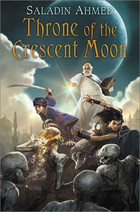
Throne of the Crescent Moon by Saladin Ahmed
A fantasy novel by a new author and the last of this year’s Hugo nominees for me. The action happens refreshingly in a generic middle age Middle East instead of a generic middle age Europe. That’s about all which is unusual in this book. The plot and especially the characters are very generic and clichéd. There is an older ghoul hunter who feels too old for this shit, a young, overzealous holy warrior and an attractive very badly underused, very badly characterized, shapeshifting young girl who serves as a love interest for the youngster. Something very evil and powerful is rising, and it is up to our heroes to save the city, country and the world. The novel feels very generic in spite of the location. There are problems with the pacing, the writing feels pretty clumsy and especially the battle scenes feel transcripts of a role playing adventure. At times, it feels like the author threw dice and consulted random encounter tables, so random some encounters felt. The magic used in the book also felt to be very "D&D" stylishs with fireballs, spells glowing in the air and so on. I also would imagine that if magic really were so powerfull and common, the society and most functions of such world would be profoundly changed. That coudn't be seen in this book. I don’t see why this book was nominated and how it has so many so positive reviews in Amazon and Librarything. Will be on the last place in my voting.
288pp.
Monday, July 15, 2013
My Hugo votes 2013, part 3, short stories
Short stories
There were only three short stories nominated this year as the votes from nomination spread too far. One story by Kij Johnson was nominated again just like in at least two previous years. I have never really understood any of her stories, but this year’s story is probably the worst of bunch. This will be on the last place and below “no award”. Ken Liu’s story was very moving and will earn the first place. Immersion took rereading before I really understood it, but it was probably the best thing I have ever read by Bodard and it was a very satisfying tale after all.
“Mantis Wives”, Kij Johnson
A very short “story” (I am not sure if this is “a story” by any definition) about the mating habits of the praying mantis. No plot, no real story or plot anywhere. 100% pure unadulterated metaphors, not even very interesting or good metaphors and nothing else.
“Immersion”, Aliette de Bodard
A story of “a developing” planet where the inhabitants of Chinese descent are using some sort of portable brain interface which helps them serve tourists better giving them insights of customs and language of the visitors. The story is told from two viewpoints – from a point of a poor girl whose family owns a restaurant, and from a point of a wife of a rich man who is hopelessly addicted and grown into the brain interface. A very good story after I got the shifting viewpoints. One small nitpick: the author doesn’t seem to understand the complexity of technology. No amateur tinkered could never, ever, reverse engineer even current high technology, it is totally ridiculous that someone would even try to do for future tech.
“Mono no Aware”, Ken Liu
A giant asteroid has hit Earth (and splinters hit Mars and Moon – talk about co-incidences!). The last humans are on a generation ship. The last Japanese got to the ship through his father’s good relations. A very well and poetically written, very sad and melancholy story with a tear producing end. A very good story in spite of a few logical inconsistencies.
Voting order:
1. “Mono no Aware”, Ken Liu
2. “Immersion”, Aliette de Bodard
3. No award
4. “Mantis Wives”, Kij Johnson
There were only three short stories nominated this year as the votes from nomination spread too far. One story by Kij Johnson was nominated again just like in at least two previous years. I have never really understood any of her stories, but this year’s story is probably the worst of bunch. This will be on the last place and below “no award”. Ken Liu’s story was very moving and will earn the first place. Immersion took rereading before I really understood it, but it was probably the best thing I have ever read by Bodard and it was a very satisfying tale after all.
“Mantis Wives”, Kij Johnson
A very short “story” (I am not sure if this is “a story” by any definition) about the mating habits of the praying mantis. No plot, no real story or plot anywhere. 100% pure unadulterated metaphors, not even very interesting or good metaphors and nothing else.
“Immersion”, Aliette de Bodard
A story of “a developing” planet where the inhabitants of Chinese descent are using some sort of portable brain interface which helps them serve tourists better giving them insights of customs and language of the visitors. The story is told from two viewpoints – from a point of a poor girl whose family owns a restaurant, and from a point of a wife of a rich man who is hopelessly addicted and grown into the brain interface. A very good story after I got the shifting viewpoints. One small nitpick: the author doesn’t seem to understand the complexity of technology. No amateur tinkered could never, ever, reverse engineer even current high technology, it is totally ridiculous that someone would even try to do for future tech.
“Mono no Aware”, Ken Liu
A giant asteroid has hit Earth (and splinters hit Mars and Moon – talk about co-incidences!). The last humans are on a generation ship. The last Japanese got to the ship through his father’s good relations. A very well and poetically written, very sad and melancholy story with a tear producing end. A very good story in spite of a few logical inconsistencies.
Voting order:
1. “Mono no Aware”, Ken Liu
2. “Immersion”, Aliette de Bodard
3. No award
4. “Mantis Wives”, Kij Johnson
Sunday, July 14, 2013
My Hugo votes 2013, part 2, novellettes
There was no clear winner in the novelette category. None of the stories was really exceptionally good, but neither any of them was really bad, in fact they were at least moderately good. Only two of the stories were science fiction and one of them only barely so. As I much prefer sf to fantasy that was a slight letdown. The first story I read was Heuvelt’s piece. I was pretty sure that I would eventually like something more than that, but I will probably put it to the first place.
“In Sea-Salt Tears”, Seanan McGuire
A fantasy story about women, who are able to turn seals by wearing a magic robe which is inherited from an older family member. A group of teenager is anxiously waiting for their own turn. One of them makes friends with a strange woman who first only visit when it is time for the ceremony where someone gets her robe. Later they become more than friends. A very bittersweet love story. Pretty good writing, but didn’t really get into the mood of the story.
“Fade To White”, Catherynne M. Valente
The story happens in an alternative world where Japan retaliated the nuclear attacks by nuclear bombardment of Seattle and other west coast US cities. The war is being fought against Japan and Russia on American soil. A significant degree of people has become infertile due to radiation, and there is a shortage of men as they needed on the battle lines. Meanwhile the life is following a rigid "American lifestyle" with father, mother and kids in a nuclear family. The father takes care of several families, though on alternative weeks. A very good story which is partly told as a memo of a propaganda commercial. The lifestyle which is being imitated is a fifties lifestyle, which isn't entirely logical if war had stretched out from what really happened.
“The Boy Who Cast No Shadow”, Thomas Olde Heuvelt
A boy who doesn’t cast a shadow befriends a boy who is made of glass and is extremely fragile. The glass boy has lived a sheltered life as the slightest hit might shatter him, but he has a dream of seeing an ocean. Together they escape from home and travel through half Europe to the coast of Portugal. The story has nothing to do with science fiction, more with magical realism and allegory. Nice writing, but somewhat too short.
“The Girl-Thing Who Went Out for Sushi”, Pat Cadigan
Most of the humans who live around Jupiter have changed themselves to look like crustaceans. A girl who has still been “two legged” decides to “go for sushi”, in other word turn herself to the sea animal look. There are several discussions and considerations before that, and there are some ulterior motives for some actions on some characters. A lot of back story for a story of this length. Enjoyable tale, but not the best possible.
“Rat-Catcher”, Seanan McGuire
The story happens apparently in the same fantasy universe as “In Sea-Salt Tears” by the same author. This time the protagonists are cats who can turn to humans. The main hero is the prince of the cat kingdom who enjoys watching theatre in the middle age London. His overbearing father summons him and has a task for him. The prince learns something which could change everything. A well-written story which was one of my favorites.
My voting order will most likely be:
1. “The Boy Who Cast No Shadow”, Thomas Olde Heuvelt
2. “Rat-Catcher”, Seanan McGuire
3. “The Girl-Thing Who Went Out for Sushi”, Pat Cadigan
4. “Fade To White”, Catherynne M. Valente
5. “In Sea-Salt Tears”, Seanan McGuire
Monday, July 8, 2013
My Hugo votes 2013, part 1, novellas
The novella category was the first I have finished this year. The quality of stories was fairly nice for the most part, but not exceptional and there was only one story which I considered to be really good and well worth of the award. The order of the other stories wasn’t very easy to determine (except for the last place) as most of them were at least moderately good but had all some clear faults. None was so bad that I would use the “no award” category, though.
“The Stars Do Not Lie”, Jay Lake (Asimov’s, Oct-Nov 2012)
A scientist finds from stars something which shakes the official doctrine of an alternative earth (or a colony planet which has been named as earth and a nearby planet has been named as "Mars". He tries to announce his findings at a scientific conference, but he is apprehended before he has a chance to do that. And there are pirates in airships, some plotting and so on. There are some good parts, but the background has somewhat unclear and the narrative was fragmentary. A readable story. But not my favorite.
The Emperor’s Soul, Brandon Sanderson (Tachyon Publications)
A wizard has been imprisoned by an empire which despises magic and even publicly denies it really works even if they use some forms of it commonly. She faces execution, but she is given a vast task: she should rebuild the personality of the emperor who barely has survived an assassination attempt. The attempt left his mind empty. By carefully studying the life of the emperor the magician might be able to succeed in that task. An excellent story with a very fascinating and interesting method of magic: By studying the material, object or people understanding them truly it is possible to rewrite their history and change them, eq. make a worn table to turn to a fine and beautiful antique piece. When the magician learns about the emperor she also leans to understand him better than anyone ever.
After the Fall, Before the Fall, During the Fall, Nancy Kress (Tachyon Publications)
A rucksack group of survivors of a major catastrophe which has rendered earth uninhabitable is kidnapping children from the present time with some sort of time machine which has been provided by strange creatures – possibly aliens or robots. A pregnant policewoman is studying the kidnappings which happen in partly predictable temporal and geographical pattern. At the same time, strange mutations are apparently spontaneously springing up in plant at different places of the world. A pretty good story, which was slightly overlong. The writing was interesting and engaging. Pity about the ending, though, it was far too deus ex machine - practically a literal deus ex machine - for me, not mention being overtly preachy.
On a Red Station, Drifting, Aliette de Bodard (Immersion Press)
The story is a part of a series where China was the most dominant nation and future spacefaring civilization follows very strict rules concerning ancestors, propriety and customs. The ancestors are not only highly revered, the carried around as some sort of brain implants which are highly valued. An apparent refugee from a planet with some rebel action has come to a space station where some distant relatives live. She isn’t exactly welcomed, but she gets a place to stay. She is a relative, after all. Then there are some plotting, intrigues and poems which were horribly offensive for some reason. The story doesn’t really work alone without knowing more about the background of the world. The writing was pretty slow to read and didn’t manage to make me care about any of the characters at all – they could all have died horrible deaths without me caring even the slightest. And I really am not interested in knowing more about that horrible nepotic and tyrannical world, if the main plot between the stories isn’t about how the rebels will completely destroy the current system of “government” and custom. Somehow I think that the series won’t be about that, but I certainly am rooting for the rebels.
San Diego 2014: The Last Stand of the California Browncoats, Mira Grant (Orbit)
A novella which is a part of author’s zombie series. Tells the story how the zombies took over the San Diego Comic Con and slaughtered thousands of genre fans. Moderately entertaining and better than the books from the series, but seem to be written for the self-gratification of the fandom telling how valiantly different fan groups fought against the horde of zombies. The writing was ok and the story was better than the novels from the series, but Hugo worthy – perhaps not.
My votes will be in this order:
1. The Emperor’s Soul
2. The Stars Do Not Lie
3. After the Fall, Before the Fall, During the Fall
4. San Diego 2014: The Last Stand of the California Browncoats
5. On a Red Station, Drifting, Aliette de Bodard
Friday, July 5, 2013
Analog Science Fiction and Fact, September 2013
A pretty average mix of stories.
FULL FATHOM FIVE, Joe Pitkin
A lone explorer is in a trapped under the ice of Europa, a moon of Jupiter. She has captured a body of an alien, which apparently died at the moment light from the vessel hit it. She has some strange dreams of her father. The body of the alien then releases a great amount of metallic compound which is badly needed to repair the radio transmitter. A pretty confusing story, which starts in the middle of a story and ends in the middle of a story. It almost felt like everything which happened was just a hallucination of the protagonist, but just almost. If the story wasn’t a hallucination, then the alien is pretty strange and is apparently capable of transmutating elements with no radiation whatsoever. ***
MURDER ON THE ALDRIN EXPRESS, Martin L. Shoemaker
The first civilian expedition of mars has ended with a death of the leader of the expedition. But there seems to be evidence, which proves that the death was intentional. The expedition wasn’t apparently very expertly leaded, but who would have committed murder and why? And is the ex-girlfriend of the first officer who took part of the ill-fated expedition somehow involved? The story consists mainly from the eyewitness accounts of what happened. An ok story, perhaps slightly overlong. ***+
THE ORACLE, Lavie Tidhar
A story about an emerging all powerful godlike artificial intelligence. A very fragmentary, at places very confusing and unclear story. This didn’t work for me at all. **-
CREATURES FROM A BLUE LAGOON, Liz J. Andersen
Working for interplanetary veterinary corps can be very demanding – especially when your working partner is a (almost) yellow submarine with an AI with some interesting characteristic. A light hearted story in the best James White style. An enjoyable read – nothing deep, but the story wasn’t meant to be something deep. ***+
LIFE OF THE AUTHOR PLUS SEVENTY, Kenneth Schneyer
Extending copyright by suspended animation may work, but there are some things which are hard to escape – like debtors. Another story in a light vein. It was probably overlong to some degree– might have worked best as a shorter Probability Zero story. ***-
THE WHALE GOD, Alec Nevala-Lee
A whale beaches in a war time Vietnam. The US army personnel tries to rescue it. Some of them see some strange shapes at a corner of their eyes, and they have strange feelings. A pretty nice story – but it is not exactly science fiction at all. By a remarkable coincidence, I read about the exact phenomenon which is described in the story just a few days before I read the tale. Pretty good and even moving story. ***+
Tuesday, June 25, 2013
2312 by Kim Stanley Robinson
The next of the Hugo-nominees. I don’t think I have read any of Kim Stanley Robinson’s books before (The Mars trilogy has been in my reading queue for a long time). This book apparently happens at the same universe somewhat later. The solar system is widely inhabited and “balkanized”, Mars has already been terraformed, Venus is undergoing terraforming and there are many habitats some of which have been built from asteroids, some are on the moons of the giant planets, all are independent more or less. The lifespan is long; the most people are hermaphrodites with both male and female genitalia. The book is more of a travelogue of the future solar system than a real novel with a real plot. There is a kind of plot, which is even somewhat interesting, but for most part it seems pretty extraneous in comparison with extremely detailed and wordy descriptions of the wonders of the solar system. The plot revolves around a terrorist attack against a giant city which moved endlessly around Mercury on tracks following the twilight zone. There are some interesting sidelines of the plot, like the more or less forced “terraforming” of Earth, which has been devastated by rising sea levels and widespread extinction of the most animal species. The plot could have been presented in half of the pages the book actually has. The characters take several sidetracks which don’t serve the main story in the slightest, but serve only in showcasing still more details of the solar system in mind numbing detail. Most of those sidetracks don’t even serve the evolving love story of the two main protagonists. Also, especially in the beginning the characters seem to be mainly bystanders with no relation to those few events which actually are happening. Maybe the book would have been more accessible for me I had read the earlier books about the same universe and would have been interested for a look into this phase of the development of our solar system. This isn’t going to be my top choices in the Hugo ballot.
561 pp.
Tuesday, June 11, 2013
Asimov's Science Fiction, July 2013

About average issue of Asimov’s.
Haplotype 1402 • shortstory by Ted Kosmatka
A post-apocalyptic story about US where a widespread and drug resistant strain of tuberculosis has killed most of the population. An advance scout of a small and ruthless partly, who travels on countryside has a bad encounter with a surviving farmer on his farm. That eventually leads to some grave consequences. A very well written story, where the background was perhaps too sketchy. ***½
The Art of Homecoming • novelette by Carrie Vaughn
A member of diplomatic corps is taking a vacation to meet her family on a farm after a failed mission. She reconnects with her family members, milks goats, eats real food and discusses things with her family. A simple story, good writing, but somehow there was practically no real plot at all. ***-
Blair's War • shortstory by Ian Watson
An alternate history story, where British forces take part to the Spanish civil war. Pretty short story which felt too long as everything is loaded at the last line reveal - which wasn't really surprising or astounding. **½
Yubba Vines • novelette by Rudy Rucker and Paul Di Filippo
A carriage which offers extremely tasty (and apparently mildly narcotic) foods appears in the town in surprising locations.
Something funny going on, as some people who have visited the diner seems to disappear. The beginning of the story was pretty good, but there were some pretty easily drawn conclusions and the ending went in a too surreal direction. **½
What is a Warrior Without His Wounds? • novelette by Gray Rinehart
An officer of Russian military is waiting for a honorable discharge after he has lost his leg and arm in a battle. Instead of a release, he gets ordered back to the very prestigious military academy he graduated from some years ago. The academy has produced some very capable and precocious cadets. There is reason for that...not very surprising story, but it is well told and written. ***+
Today's Friends • shortstory by David J. Schwartz
Aliens have appeared everywhere. Mostly they just observe, but they have a strange fascination on music. If they hear any music or even musical sounds - even bird song - they enter the mind of a person (or animal) who is responsible for the sound and force them to repeat it several times. And usually they rip the brain more or less to shreds at the same time. The protagonist of the story makes a mistake by humming at a public place. He is deeply scarred and changed after an alien fingers his brain. A well-written story - perhaps slightly too short. ***+
At Palomar • novelette by Rick Wilber
Apparently several forces battle for the control of several alternative worlds. A former baseball player is supposed to kill a certain person on a world, where part of the US is ruled by Germany and another part by Japan. The new optic lens which is being transported to the Palomar observatory has an important role. Extremely similar background as in the story by Kristine Kathryn Rush a few issues ago. This was lot less good, though. The back plot was a little confusing - there apparently has been a former part and the story was slightly too talky. ***-
Tuesday, June 4, 2013
Captain Vorpatril's Alliance by Lois McMaster Bujold

A Hugo award nominee. A book which is part of the Vorkosigan series, but has the usual main character Miles Vorgosigan in only a very superficial role. The main protagonist of the book is Miles’s cousin Ivan Vorpatril, who is in a fairly high place in the line of possible successors to the throne of Barrayar, but has always tried to keep a low profile and to avoid anything, which would make him appear as any sort of competitor of that title. He has lived as a middle level officer of the Barrayar military and has usually had very active bachelor life. The book starts when a friend of his, Imperial Security agent Byerly Vorrutyer asks him to protect a beautiful woman who might be in some sort of danger. About 24 hours later he finds himself to be a married man due to some very special circumstances. And he is going to face some explaining to do for his mother and other relatives. And that’s the starting point of the novel – there are many twists along the way, especially after the in-laws arrive.
This was a fun book! Much better than the Bujolds previous Hugo nominee two years ago – which was about the worst of her books I have read. This was about the best one. It was very entertaining, funny and witty with something for everyone (in a good way): romance, action and comedy all in good balance. The book also works very well as a single story even though it is a part of a ling series. As matter of fact, it might even be a good starting point for the whole series, as the Barrayar and Barrayarian culture and society are seen mainly from the point of view of someone who isn’t familiar with it. After I have read three of the nominees in the novel series this is my leading candidate by far.
422 pp.
Subscribe to:
Posts (Atom)


