Wednesday, May 14, 2014
Hallucinations by Oliver Sacks
The latest book by Oliver Sacks. This time he presents several case studies (or more like anecdotes) about different sorts of hallucinations - visual, auditory and even some other forms of that intriguing phenomenon. However, he is recycling his anecdotes by now, and the book isn’t anywhere as interesting as some of his earlier works - even though many of the stories _are_ familiar from the earlier books. The stories also tend to repeat themselves, there several very similar ones. Many of them weren’t really unusual – at least not for a neurologist. Almost every page has a foot note, which makes reading less smooth it might be. There were some surprising revelations: apparently Oliver Sachs was pretty heavily into the drugs in the sixties, taking about everything he could get in his hands, up to and including antiparkinson medications at extremely high doses. Well, _that_ caused some pretty unusual and very realistic hallucinations… As a whole the book was readable, but probably I will resist the temptation and won’t buy his possible next book: the law of diminishing returns seems to work.
320 pp.
Thursday, May 8, 2014
Analog Science Fiction and Fact, March 2004
A pretty good issue.
Greater Fleas Have Lesser Fleas • novelette by Grey Rollins
A farmer whose farm can’t compete against giant industrial farming units sells his farm and finds a way to travel to an alien planet as a stowaway on an alien spaceship. The planet seems o be a virgin one. There are a few human settlers, but for some reason no aliens can be seen anywhere. As the farmers apparently are pretty stupid, they only think about that in passing. Then the aliens show up – and they have a small revelation. I can’t imagine why the aliens would reveal their secret to humans – or is there some other goal after all? ***+
Draft Dodger's Rag • novelette by Jeff Hecht
A pot smoking youth wants to escape the Vietnam War. He gets a wonderful offer: time travelers from a very peaceful future want to experience war. Someone takes his place and then he travels a few years to the future and gets his life back. He takes the offer, but doesn’t ask to extremely obvious question: what happens if his counterpart manages to get himself killed? And that is what happens. The writing is pretty good and the story was interesting. The choices to protagonist made weren’t always logical. ***+
Storm Front • [Draco Tavern] • shortstory by Larry Niven
A Draco Tavern story – Being from another sun are apparently asking for a refuge in ours sun. Short, chatty and without much point. **½
Babel • [Silurian Tales] • shortstory by Steven Utley
A talk by creation "scientist" explaining who evolution is wrong events after a discovery of an anomaly leading to the distant past. Far too longer, isn't amusing - rather depressing. **½
Distant Fire • shortstory by Richard A. Lovett
A story about a really long term love affair. An actress and an astronaut fall desperately in love. When the astronaut gets a captaincy on the first interstellar star ship they will never see each other’s ever again. Or will they? The actress goes to suspended animation to wait out for her boyfriend who returns hundreds of years later old a few years older thanks to time dilation. They spend a few years together, until they do it again…A pretty good, fairy tale like story. ***½
The Color of Pain • novelette by James C. Glass
Colonists on a planet have trouble with worm like creatures which spread extremely toxic gas when they are threatened – or even when there are not. Could they be intelligent? Could there be a way to communicate with them? A pretty standard story with pretty standard plot and characters. ***
Sunday, May 4, 2014
Analog Science Fiction/Science Fact, July 1976
A pretty bad issue. The first story was sort of okay, Schmidt’s story was kind of readable, the other two were bad.
Tricentennial • shortstory by Joe Haldeman
A story about space exploration and human history. A ship is sent for a test drive, but the passengers hijack it and aim for starts. A lot of political wrangling is needed even before the ship is sent. I wonder why a space ship in 2076 would be named to honor people important from the perspective of 1976? Not everything goes smoothly – not on the ship, and not on earth. Somewhat "outline style" of story where things are mainly described. ***+
Fly • shortstory by Mal Warwick
A story that aims for beautiful and poetic language and succeeds so well, that I didn’t really understand much. The story deals with a church, spaceship and love - apparently. **-
His Loyal Opposition • novelette by Stanley Schmidt
Continues an earlier story (which I haven’t read). Aliens (or space faring humans) have apparently visited a medieval planet and left behind a floating ship. A violent tribe might soon attack, and those ships just might save the day. Then a member of the enemy tribe apparently defects. Could he be trusted? There wasn’t much real sf content in this story. It was readable, but not really anything special. ***-
Dolls' Demise • shortstory by George Guthridge
A short shaggy dog style of story with a stupid "point". Unfunny and really, really stupid. *
Thursday, May 1, 2014
Hanna Jensen: 940 päivää isäni muistina
A story about a father with dementia. An interesting and fascinating view how a disease which causes cognitive problems is seen prom the perspective of an adult child, who is forced to take care of her parent.
Monella tasolla mielenkiintoinen kirja dementiasta omaisen näkökulmasta katsottuna. Omalla omaisellani on nopeasti pahentunut muistihäiriö ja oman työni tiimoilla muistiasiat ovat enemmän kuin tuttuja. Kirjassa toimittajatytär kertoo isänsä tarinan. Aikaisemmin hiukan särmikkään persoonan omannut, hyvin aktiivinen ja ulkonäöstään tarkkaa huolta pitänyt mies muuttuu passiiviseksi, tahraisissa olohousuissa sujuvasti liikkuvaksi mutta aikaisempaa sävyisämmäksi ihmiseksi. Isän muistihäiriö oli päässyt jo varsin vaikeaksi siinä vaiheessa kun omaiset asian huomasivat. Usein käytännössäkin käy näin, vähitellen ja hitaasti tapahtuvia muutoksia on vaikea huomata. Kirjassa puhutaan Alzheimerista, mutta oireiden, niiden etenemisen ja muiden tekijöiden perusteella arvioiden vaikuttaa täysin selvältä, että kyseessä on ollut sekamuotoinen dementia, jossa on ollut mukana verenkiertoperäisistä syistä johtuvaa oireistoa ja erittäin todennäköisesti myös alkoholin käytöstä johtuvaa oireistoa. Tuota alkoholiasiaa ihmettelin suuresti, miten ihmeessä jo kohtalaisen pahasti muistihäiriöiselle alkoholin suurkuluttajalle tytär kantaa tolkuttomia määriä alkoholia kotiin? Minkälainen sokeus tai asioiden kieltäminen tuollaisessa toiminnassa mahtaa olla taustalla? Mahtoivatko hoitavat lääkärit olla käyttömääristä tietoisia? Mielenkiintoista oli myös se, että lääkäri joka väheksyi muistioireita ja piti jo ilmeisen vähintään keskivaikeasti dementoituneen oireita ihan lievinä oli ”hyvä lääkäri”. Etenkin, kun on oletettavaa, että katastrofaalinen sairaalasta kotiutusyritys on jossain määrin laitettava tuon huonosti kokonaistilannetta kuvanneen sairaalalähetteen piikkiin. (Jos lähetteen mukaan kyseessä on vain lievästi dementoitunut ja täysin omatoiminen henkilö, niin sairaalassa akuuttiosastolla lähtökohtaisesti oletetaan, että tämä pitää paikkaansa ja akuutin oireen hoidon jälkeen henkilö on taas kotikuntoinen). Ajattelemisen aihetta kirja antoi runsaasti ja se on kirjoitettu erittäin luettavasti ja vetävällä tyylillä. Loppupuoli kirjasta meni väsyneenäkin yötä myöten loppuun asti yhdellä kertaa.
289 s.
Sunday, April 27, 2014
Cyteen by C. J. Cherryh
A massive novel which feels even longer than it is. The book starts with a huge infodump where the history of the background is explained. Then a massive number of characters is introduced. It took some time to get in to the book – for some degree I never got into it. Practically everything in the book is presented as discussions. People discuss, discuss, discuss. For variety’s sake sometimes there are some introspective self-reflective musings of some character and an occasional discussion with a computer program. There is little else than some sort of discussion (after the infodump) in the book. Practically nothing is described; nothing is presented as a straight narrative, everything is presented by different sorts of discussions.
Cloning is commonplace. There are sort of “worker drone” clones which have been brain washed with “tapes” for menial task. There are also clones of certain especially intelligent people which are reared to be as similar as possible as their counterparts. A woman has been the leader of the most important research laboratory for decades. She looks young due to sophisticated longevity treatments, but is over 100 years old. She seduces a seventeen-year-old clone, who severely traumatized by the experience. (Seventeen-year-old adolescent boy who is severely traumatizes by sex??) His father later finds out and the female scientist ends up as dead. It might have been an accident, but the father is pressured to confess murder. Later a clone of the deceased woman is created. She is reared in as similar conditions as possible as her clone parent, so that her personality and intelligence would be similar. Her predecessor has left behind a sophisticated computer program which offers advice for her actions. It seems that she will be even more brilliant than her “mother”. She slowly starts to regain her clone mother’s positions in the society at very young age. There is a lot of different sorts of scheming, and fairly little happens. The ending felt very abrupt, however. It is also surprising, that the ethical considerations of using cloned, programmed human clones for menial tasks is hardly explored.
Not among my favorites among the Hugo-award winners. (now over 90% of all of them read).
696 pp
Tuesday, April 22, 2014
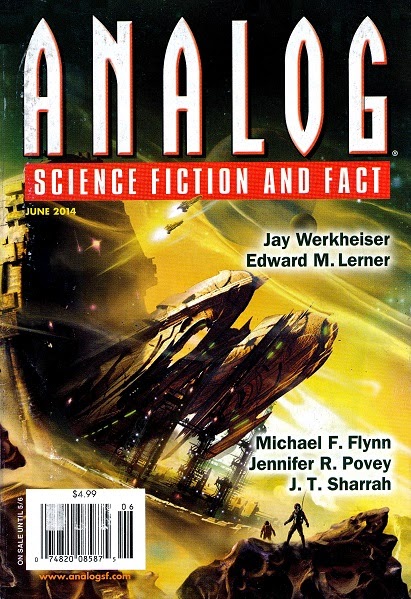
Analog Science Fiction and Fact, June 2014
Pretty average issue with some good and some not so good stories.
Field of Gravity • shortstory by Jay Werkheiser
A sports story about a future version of American "foot"ball with an added twist of gravity manipulation. It seems that someone is able to manipulate gravity fields in a new manner and is using it to hurt other players. A lot of boring descriptions of gameplay. Not my cup of tea. **½
The Journeyman: In the Stone House • [Journeyman] • novelette by Michael F. Flynn
Continues an earlier story. Two men have combat training, have some fights and engage in light batter. Very much an excerpt from a longer story. Not really science fiction -there seems to be some relics of a space faring civilization around, but they have little real meaning for the plot. ***-
The Region of Jennifer • shortstory by Tony Ballantyne
A beautiful girl has been reared for her entire life for an important marriage. A genetic mutant who used to know her comes to rescue her just before the marriage. But he might not grasp the whole situation and how well reared she really is for that position. A very good and well written story. ****-
Survivors • shortstory by Ron Collins
An alien who has survived an ancient disaster and has masqueraded as a human for thousands of years finds an another survivor. But she runs away. Why? Not bad, not a new idea but with a nice twist and nice writing. ***½
Forgiveness • shortstory by Bud Sparhawk
There are veterans of a cruel war who have been pardoned and made to forget what crimes against humanity they have done. One man who might be a veteran has arrived at a small town. The sheriff of the town has a lot of prejudices against him, especially as his former girlfriend seems to take an interest to the new man. A pretty nice story with not entirely unexpected ending. ***½
A Star to Steer By • shortstory by Jennifer R. Povey
A story of a sentient ship, who has lost her human crew. She/it retrofitted to a new ship without any change of recuperating, as humans are losing the war. While on a test run she must face a severe choice. Well written, very short story. ***+
The Homecoming • novelette by J. T. Sharrah
An alien warcrimal wants to be buried by the traditional means of his people. (Being eaten by a carnivorous plant) and there is a lot of different sorts of plotting. A lot of backstory, a lot of characters, a lot of pretty stupid lecturing and explaining (the end is presented by one character explaining in detail what happened and why.) Not very good story. **
Tuesday, April 15, 2014
Aki Ollikainen: Nälkävuosi
A short novella or rather novella about the last famine in Finland at 1860s. A well written, extremely moving book with people, who feel very real in all their misery, and in their sometimes evil and sometimes extremely compassionate actions.
Lyhyt 1800-luvun nälkävuosista kertova kirja. Teos on pituudeltaan enemmänkin novelli, mutta se ehtii kertomaan hyvin liikuttavan ja tunteisiin vetoavan tarinan yhden perheen onnettomasta kohtalosta. Mukana on myös lyhyitä välähdyksiä paremmin toimeentulevan väen ja hallinnon elämästä. Nämä osuudet olivat ehkä hiukan liian lyhyitä, kokonaisuutenakin liian lyhyessä kirjassa. Kielellisesti kirja on hieno ja nautittavalla, mutta samalla luettavalla kielellä (toisin kuin vaikkapa ”Jokapäiväinen Elämämme”) kirjoitettu. Ihmiskohtalot olivat liikuttavia, hyvin kuvattuja ja muutenkin ihmiset olivat hyvässä ja pahassa elävän ja aidon tuntuisia. Muutama pornonovelliin paremmin sopiva kohtaus vaikutti kyllä hiukan irralliselta ja erittäin turhalta.
141 ss.
Thursday, April 10, 2014
Salla Simukka: Punainen kuin veri ( As Red as Blood!)
A widely translated (sold to app. 25 different countries) Finnish YA-book, which happens to happen on my home town. A young girl with troubled past finds blood soaked bank notes from the dark room of her school. Soon she is involved with not only the most popular kids of the school, but with drug dealing criminals. An entertaining and fast read with intriguing and real characters.
Helsingin kirjasto tarjoaa nykyään aika mukavan valikoiman e-kirjoja lainattavaksi. Aino ongelma on sama kuin normaalienkin kirjojen kohdalla, suuri osa kiinnostavimmista teoksista on yleensä lainassa. Nuortenkirjoja en erityisen usein lue, mutta tämä herätti kiinnostuksen: kansainvälinen myyntimenestys suomalaiselta kirjailijalta, joka vielä tapahtuu Tampereella.
Lumikki Andersson on Tampereella kuvaamataitolukiossa opiskeleva, toiselta paikkakunnalta kotoisin oleva tyttö, joka ei juuri muuta halua kuin olla herättämättä huomiota. Sattumalta hän löytää koulun pimiöstä verestä pestyjä suuria seteleitä kuivumasta. Pian hän huomaa olevansa monenlaisen huomion kohteena ja koulun pintaporukan kanssa samoissa juonissa mukana. Tarinaan liittyy nyt jopa kirjoittamisajankohtaa ajankohtaisempaa huumepoliisin korruptiota ja varsin tukalia ja pelottavia käänteitä ennen sopivan onnellista loppua.
Kirja on varsin sujuvaa ja nopealukuista tekstiä. Nuortenkirjamaisuus näkyy ehkä eniten henkilöiden iässä, tekstinä se ei mitään erityisen yksinkertaista ollut – kirja voittaa kyllä vaikka Leena Lehtolaisen uudemmat romaanit. No itse asiassa Henkivartijan jälkeen en koko kirjailijaan ole enää koskenut, joten osaa arvioida olisiko uudemmissa kirjoissa laadussa tapahtunut kohentumista. Lumikki on mielenkiintoinen, joskin hiukan kliseisen koulukiusattu hahmo. Sinällään hän oli varsin mielenkiintoinen tuttavuus ja ehkä pitää ainakin seuraava osa jossain vaiheessa lukaista, ainakin jos verkkokirjaston hyllyllä tulee vastaan. Tampere kirjassa oli oikeastaan yllättävän pienessä roolissa, paljon pienemmässä kuin vaikkapa Seppo Jokisen kirjoissa.
265 s.
Subscribe to:
Posts (Atom)