Friday, July 15, 2016
Seppo Jokinen: Hukan enkelit
A police procedural which happens at Tampere, my home town. Someone apparently is killing disabled people. A very well written book with well-presented characters and engaging plot. No wonder that it won an award as the best crime book of the year in Finland.
Komisario Koskinen selvittelee tällä kertaa vammaisiin kohdistunutta rikossarjaa. Selkäydinvammainen mies löytyy tapettuna ilman pyörätuoliaan. Selvästi joku on kuljettanut ruumin löytöpaikalla, mutta kuka, ja miksi vaikeasti vammainen mies on tapettu? Tarkemmin asiaa tutkittaessa käy ilmi, että mies oli varsinainen kiusankappale ja juuri kukaan, ei edes lähimmät ryyppykaverit, tuntenut kovin lämpöisiä ajatuksia häntä kohtaan. Hetken kuluttua jo toinen saman hoitokodin asukki löytyy kuolleena. Tällä kertaa uhri oli vanha nainen, joka ei koskaan ärsyttänyt ketään. Onko hoitokodin asukkaiden kimpussa sarjamurhaaja? Samalla Koskisen työkavereiden keskinäisissä suhteissa on omat ongelmansa, ja toisaalta jo jonkin aikaa sitten eronnutta miestä ystävät yrittävät uutterasti parittaa. Uskottavalta vaikuttavan poliisityön tuloksena tapaus lopulta ratkeaa.
Selvästi keskitasoa paremmalla puolella oleva Koskinen. Käsiteltävä asia on ajatuksia herättävä, teksti on sujuvaa ja ihmiset ovat pääosin aidon, uskottavan oloisia. Huomattava parannus edelliseen, Kreikassa tapahtuneeseen kirjaan verrattuna. Ei ihme, että voitti ilmestymisvuotenaan parhaan dekkarin palkinnon.
356 s.
Tuesday, July 5, 2016
My Hugo award votes 2016, part 3: Short stories
Most of the nominees in this category originate from the slate of rabid dogs. In this category they didn’t use the “human shield” method, but purely used the trolling approach. I wonder why the misogynist and homophobic losers nominated a gay porn story? Well, such opinions certainly hint to severe problems with sexuality – perhaps a choice made purportedly as trolling reveals something about their real, repressed, preferences. The one story which didn’t come from the slate was the only one tolerable. However, I don’t believe it is an award-worthy story, and as there was no fair competition, I will use “no award” as the first choice. The cat story will be on the second place. The gay story actually was pretty funny and vastly better than the other, especially the Castallia House, choices. The rest won’t be on my ballot.
“Cat Pictures Please” by Naomi Kritzer (Clarkesworld, January 2015)
An AI has appeared to computer networks apparently spontaneously. It takes interest in some people’s life – especially those who post pictures of cats. As she (it?) can’t take any direct action the people she tries to help but most people won’t even notice hints she tries to give or subtle influence she can have. But at least there are lot of cat pictures on the net, so everything isn’t bad and the AI can entertain herself easily enough. And at least someone’s life seems to go to better direction... A fun and amusing story.
Space Raptor Butt Invasion by Chuck Tingle (Amazon Digital Services)
Gay porn which describes an encounter between a lonely astronaut on an outpost and an intelligent velociraptor. Short, silly and nowhere award worthy. Slightly better I was expecting, but I was expecting something very bad. The anatomy of the velociraptor didn’t seem to be very accurate…somehow I don’t think dinosaurs were so well endowed.
“Seven Kill Tiger” by Charles Shao (There Will Be War Volume X, Castalia House)
Chinese release or at least plan to release a disease which will kill all Africans, so that they will be free to exploit the natural resources on the continent. An extremely racist and despicable story.
“If You Were an Award, My Love” by Juan Tabo and S. Harris (voxday.blogspot.com, Jun 2015)
A piece of shit which was “written” by someone who is consumed by hatred for people who are not racists and actual can write good fiction. A strong motivator is the strange hatred some deranged people have towards John Scalzi. I can’t really understand what is behind that? Jealousy most likely. The story tries to be a parody of a story hated by puppies, rapid and sad both. I wasn’t a great fan of that story, but I don’t get the great hatred, either.
“Asymmetrical Warfare” by S. R. Algernon (Nature, Mar 2015)
A short story published in Nature. Apparently the editors of that fine magazine aren’t very good at judging science fiction. The story tells about starfish like aliens who are not able to recognize that humans don’t regenerate after split in two halves. The writing was so and so, the concept was totally ridiculous: a space faring species with no biological insight at all?
My voting order will be:
1. No award
2. “Cat Pictures Please” by Naomi Kritzer (Clarkesworld, January 2015)
3. Space Raptor Butt Invasion by Chuck Tingle (Amazon Digital Services)
“Cat Pictures Please” by Naomi Kritzer (Clarkesworld, January 2015)
An AI has appeared to computer networks apparently spontaneously. It takes interest in some people’s life – especially those who post pictures of cats. As she (it?) can’t take any direct action the people she tries to help but most people won’t even notice hints she tries to give or subtle influence she can have. But at least there are lot of cat pictures on the net, so everything isn’t bad and the AI can entertain herself easily enough. And at least someone’s life seems to go to better direction... A fun and amusing story.
Space Raptor Butt Invasion by Chuck Tingle (Amazon Digital Services)
Gay porn which describes an encounter between a lonely astronaut on an outpost and an intelligent velociraptor. Short, silly and nowhere award worthy. Slightly better I was expecting, but I was expecting something very bad. The anatomy of the velociraptor didn’t seem to be very accurate…somehow I don’t think dinosaurs were so well endowed.
“Seven Kill Tiger” by Charles Shao (There Will Be War Volume X, Castalia House)
Chinese release or at least plan to release a disease which will kill all Africans, so that they will be free to exploit the natural resources on the continent. An extremely racist and despicable story.
“If You Were an Award, My Love” by Juan Tabo and S. Harris (voxday.blogspot.com, Jun 2015)
A piece of shit which was “written” by someone who is consumed by hatred for people who are not racists and actual can write good fiction. A strong motivator is the strange hatred some deranged people have towards John Scalzi. I can’t really understand what is behind that? Jealousy most likely. The story tries to be a parody of a story hated by puppies, rapid and sad both. I wasn’t a great fan of that story, but I don’t get the great hatred, either.
“Asymmetrical Warfare” by S. R. Algernon (Nature, Mar 2015)
A short story published in Nature. Apparently the editors of that fine magazine aren’t very good at judging science fiction. The story tells about starfish like aliens who are not able to recognize that humans don’t regenerate after split in two halves. The writing was so and so, the concept was totally ridiculous: a space faring species with no biological insight at all?
My voting order will be:
1. No award
2. “Cat Pictures Please” by Naomi Kritzer (Clarkesworld, January 2015)
3. Space Raptor Butt Invasion by Chuck Tingle (Amazon Digital Services)
Monday, July 4, 2016
My Hugo award votes 2016, part 2: Novelettes
Novelettes were not as good as novellas. The main theme was violence and war as several nominees were from the rapid puppies list. And even the one story which didn’t originate from there was overviolent with more swearing than I have read anywhere for long time. King’s story was pretty good but as it belongs to a different genre (it perhaps could best be described as fantastical horror), it is hard to compare with the others. I wasn’t a great fan of any of the other stories. I am not sure if any of these are good enough for an award. I was toying with “no award” on the first place, but decided against that. Folding Beijing was a decent novelette and I decided to put it on the first place. King’s story is another which will be above “no award”.
“Folding Beijing” by Hao Jingfang, trans. Ken Liu (Uncanny Magazine, Jan-Feb 2015)
Peking consists of three cities that coexist at the same place. The first city is where the rich people live, and the third is where waste recyclers live. Every city folds away and its inhabitants are in suspended animation in a cocoon when it isn't their turn to be awake. A man from the third city makes a journey to the first to earn a great reward. A nice idea, but there are some structural problems and the story seems fairly fragmented. It isn't a bad one, though. And it feels even better after I read the other nominees.
“What Price Humanity?” by David VanDyke (There Will Be War Volume X, Castalia House)
A soldier wakes inside an apparent virtual reality simulator. He assumes that he has had an accident, and his body is being repaired by nano-machines, but the simulation is pretty low quality, and his is all but forced to perform simulated combat runs against the alien enemy (which is almost beating the human forces) in the real world. Have they been captured by the enemy. or what is going on? A fairly good but pessimistic story with more than a few holes. I suspect there would have been volunteers, and the arguments the characters themselves stated against the simulation being by the Earth forces were valid. Also, smoking in the future? In space? Really? The writing was ok.
“Flashpoint: Titan” by CHEAH Kai Wai (There Will Be War Volume X, Castalia House)
Unknown spaceships attack the colony on Titan. Joint American and Japanese forces beat them, but not easily. It turns out that this was preparation by the Chinese to conquer the colony and get control of most of the volatiles used as fuel for space ships. A lot of long battles, not much else. Also, extremely, unreasonably, evil Chinese. Some very strange tactical errors. (Retracting heat radiators is apparently a very aggressive maneuver, which surely means hostile intent. Hostile spaceships on a clandestine suicide mission on ships rigged to self-destruct retract their heat radiators – and tell everyone they are hostile even before they attack)? The battles were fairly entertaining in spite of that, though.
“Obits” by Stephen King (The Bazaar of Bad Dreams, Scribner)
A young journalist works for a sleazy net site which specializes mostly on mocking celebrities. He is writing a column where he writes insulting obituaries. He isn’t too happy about his job or pay and decides to quit. To get out some of his anger, he writes an insulting obituary about his obnoxious boss. Next day, she is dead. Surely that was a coincidence. Next, he writes an obituary about a sleazy record producer who murdered the main character's favorite singer (Andi McCoy!) and is in prison. He is killed in a prison quarrel. What should he do next? Pretty good story which written in a clear style; typical for King.
“And You Shall Know Her by the Trail of Dead” by Brooke Bolander (Lightspeed, Feb 2015)
A tough mercenary woman is forced to rescue a son of a crime lord from some sort of computer system – and at the same time, find and rescue his partner’s consciousness from the same system. The story has a pretty unsympathetic main character and a vast amount of swearing. Swearing almost never irritates me, but this story passed my threshold. I wasn’t too keen on the writing – it felt fairly confusing. In part that was intentional, but I really didn’t get why exactly I should care for these protagonists.
My voting order will be:
1. “Folding Beijing” by Hao Jingfang, trans. Ken Liu (Uncanny Magazine, Jan-Feb 2015)
2. “Obits” by Stephen King (The Bazaar of Bad Dreams, Scribner)
3. No award
4. “And You Shall Know Her by the Trail of Dead” by Brooke Bolander (Lightspeed, Feb 2015)
5. “What Price Humanity?” by David VanDyke (There Will Be War Volume X, Castalia House)
6. “Flashpoint: Titan” by CHEAH Kai Wai (There Will Be War Volume X, Castalia House)
“Folding Beijing” by Hao Jingfang, trans. Ken Liu (Uncanny Magazine, Jan-Feb 2015)
Peking consists of three cities that coexist at the same place. The first city is where the rich people live, and the third is where waste recyclers live. Every city folds away and its inhabitants are in suspended animation in a cocoon when it isn't their turn to be awake. A man from the third city makes a journey to the first to earn a great reward. A nice idea, but there are some structural problems and the story seems fairly fragmented. It isn't a bad one, though. And it feels even better after I read the other nominees.
“What Price Humanity?” by David VanDyke (There Will Be War Volume X, Castalia House)
A soldier wakes inside an apparent virtual reality simulator. He assumes that he has had an accident, and his body is being repaired by nano-machines, but the simulation is pretty low quality, and his is all but forced to perform simulated combat runs against the alien enemy (which is almost beating the human forces) in the real world. Have they been captured by the enemy. or what is going on? A fairly good but pessimistic story with more than a few holes. I suspect there would have been volunteers, and the arguments the characters themselves stated against the simulation being by the Earth forces were valid. Also, smoking in the future? In space? Really? The writing was ok.
“Flashpoint: Titan” by CHEAH Kai Wai (There Will Be War Volume X, Castalia House)
Unknown spaceships attack the colony on Titan. Joint American and Japanese forces beat them, but not easily. It turns out that this was preparation by the Chinese to conquer the colony and get control of most of the volatiles used as fuel for space ships. A lot of long battles, not much else. Also, extremely, unreasonably, evil Chinese. Some very strange tactical errors. (Retracting heat radiators is apparently a very aggressive maneuver, which surely means hostile intent. Hostile spaceships on a clandestine suicide mission on ships rigged to self-destruct retract their heat radiators – and tell everyone they are hostile even before they attack)? The battles were fairly entertaining in spite of that, though.
“Obits” by Stephen King (The Bazaar of Bad Dreams, Scribner)
A young journalist works for a sleazy net site which specializes mostly on mocking celebrities. He is writing a column where he writes insulting obituaries. He isn’t too happy about his job or pay and decides to quit. To get out some of his anger, he writes an insulting obituary about his obnoxious boss. Next day, she is dead. Surely that was a coincidence. Next, he writes an obituary about a sleazy record producer who murdered the main character's favorite singer (Andi McCoy!) and is in prison. He is killed in a prison quarrel. What should he do next? Pretty good story which written in a clear style; typical for King.
“And You Shall Know Her by the Trail of Dead” by Brooke Bolander (Lightspeed, Feb 2015)
A tough mercenary woman is forced to rescue a son of a crime lord from some sort of computer system – and at the same time, find and rescue his partner’s consciousness from the same system. The story has a pretty unsympathetic main character and a vast amount of swearing. Swearing almost never irritates me, but this story passed my threshold. I wasn’t too keen on the writing – it felt fairly confusing. In part that was intentional, but I really didn’t get why exactly I should care for these protagonists.
My voting order will be:
1. “Folding Beijing” by Hao Jingfang, trans. Ken Liu (Uncanny Magazine, Jan-Feb 2015)
2. “Obits” by Stephen King (The Bazaar of Bad Dreams, Scribner)
3. No award
4. “And You Shall Know Her by the Trail of Dead” by Brooke Bolander (Lightspeed, Feb 2015)
5. “What Price Humanity?” by David VanDyke (There Will Be War Volume X, Castalia House)
6. “Flashpoint: Titan” by CHEAH Kai Wai (There Will Be War Volume X, Castalia House)
Saturday, July 2, 2016
My Hugo award votes 2016 part 1 : Novellas
The rabid and sad puppies were influencing voting again this year. The approach was a bit different: the sad puppies collected nominees openly on their net site, and their suggestion list was pretty ordinary – mostly things which most likely were going to be pretty popular, anyway. The rabid puppies' ring leader took a bit different approach. He pushed partly for choices, which were going to be nominated anyway, partly for very militaristic, violent stories and partly, especially in the short stories category, purely trolling choices. As last time, practically everything he pushed for nomination ended below “no award”. Now he apparently uses a “human shields” approach, trying to prevent that from happening and partly nominated stories which were going to be nominated anyway. Last year I nominated on merit after reading everything (and put most things below “no award”), and this time I will do the same. I will read everything and nominate based on merit. It seems there will be fewer things below “no award” than last year, but there will some, but not in this category. I have used that choice, even before those puppy lovers appeared to ruin voting for everyone, and mostly likely, I will be using that even after they are nothing more than a despised bitter memory.
Novellas is the first category I have finished. The stories were much better than last year – it hardly would have been possible to be worse. The stories were mostly pretty decent – only one was so bad – or rather irritating – that I will leave it away from my voting list. I haven’t yet decided if I’ll use the “no award” choice. The top three were pretty obvious, as was the last one. The order of the top three wasn’t as easy to decide; the best was, after some thought, pretty obvious. The second and third place might have gone the other way around, but Penric’s Demon was such a fun story that I will place it before the Reynolds’ story.
Penric’s Demon by Lois McMaster Bujold (Spectrum)
A young man who is a younger son of a very minor country lord, gets infected with a demon when the old woman who was carrying it dies unexpectedly. The “symbiosis” takes some getting used to from both parties, but it seems than the match is better than anyone could have expected. But not everyone is happy when a “no one” gets a coveted demon. The story happens in the same world as the Chalion series, but is much better than Paladin of Souls – the only book I have read from that series. (This novella uses less time on selecting clothes, but even this story does use a few pages on that subject…). The story has a very interesting and endearingly naïve but open-minded main character and is well written. Not bad.
Perfect State by Brandon Sanderson (Dragonsteel Entertainment)
A hero has mastered the magic that rules everything and conquered the known world. He gets an order: He should reproduce and he gets a list of compatible women. Real women. All his life he has lived in a virtual world designed to give him the best of possible lives, completely designed for his personality. Almost everyone in the world lives as detached brains stored somewhere and spend their consciousness on computer created worlds, whole worlds filled with virtual inhabitants. But now he must meet another real human and reproduce. From spite he selects the least suitable candidate and goes to meet her on another virtual world. But he really wasn't prepared for that meeting... A pretty good story with nice characters. The writing as such wasn't the most eloquent but very solid. A good story.
Binti by Nnedi Okorafor (Tor.com)
A young woman from a desert tribe goes to an intergalactic university as the first of her people. During the journey, their ship is boarded by aliens and everyone excepts her (and the pilot) is killed. She happens to have a strange ancient artifact that she happened to find from the desert and the mixture of flower oils and clay she uses to cover her body and BOTH of those have powerful effect to the aliens. Really? The writing was good but the plot depends on totally ridiculous coincidences. The main character was pretty irritating, too. The writing was very good, but the pretty poor plot ruined the story for me.
The Builders by Daniel Polansky (Tor.com)
A group of anthropomorphic animals, lead by a battle hardened mouse, try to defeat a toad, who is now the leader of the realm. He won the earlier battle after someone turned traitor. Now it is time for revenge. The mouse assembles again the “old gang”, makes a well planned, but extremely bloody, attack against the corrupt and evil leader. A strange cross of the three musketeers, a dark fantasy, and a fairy tale. The fable-like language and extremely brutal content were extremely irritating. I also don’t understand why the characters had to be animals; there was no real reason for that. By far the least favorite nominee for me.
Slow Bullets by Alastair Reynolds (Tachyon)
A war is ending. A solder is almost killed by a war criminal. She is rescued by peacekeepers and sent away on a transport. She wakes up a lot later - at least hundreds, possibly thousands of years have passed. Apparently, there has been some sort of accident. The transport is failing, and the worst war criminal is on loose on it. What has happened? Is there any way to repair the ship? What should the survivors do? What could they do? And all memory devices onboard are failing - possibly most of the human knowledge might soon be lost. The story is pretty good, after a little confusion at the start, and goes somewhere I was not expecting. The writing was nice and ideas were thought-provoking. It is very hard to believe that there no provisions for any sort of backups of computer systems and no personal removable storage space (other than the one exemption).
My voting order will be:
1. Perfect State by Brandon Sanderson (Dragonsteel Entertainment)
2. Penric’s Demon by Lois McMaster Bujold (Spectrum)
3. Slow Bullets by Alastair Reynolds (Tachyon)
4. Binti by Nnedi Okorafor (Tor.com)
Wednesday, June 22, 2016
Uprooted by Naomi Novik
Every ten years, a local wizard, Dragon, takes a seventeen-year-old girl (the most special girl from that age class), and keeps her for ten years. He releases her with a good amount of silver, and usually, the girl stays in her home village for only a short while before going to a larger city. The villagers give girls to Dragon, as he is the only one who is able to keep the influence of a nearby forest in check. The forest is evil, and everything that comes from there is corrupted and changed. Even pollen brought by wind causes plants to bear fruits that are deadly dangerous.
Agnieszka will be among the girls Dragon chooses as his companion. She might be selected. She and her parents aren’t very afraid, though. She is pretty plain and extremely clumsy, always with a dirty face and torn hem. Her best friend, Kasia, is the most beautiful and smart girl in the village, with wonderful grace, and everyone is sure that she will be the one picked. To everyone’s surprise, Dragon picks Agnieszka. Life in the castle seems pretty grim at first, but it turns out that Agnieszka is a witch who wasn’t aware of her abilities. Dragon tries to teach her, but with poor results, as she doesn’t seem to really grasp the kind of magic Dragon uses. But there might be other styles of magic…
A pretty good book, especially the beginning. The later parts, with more action, weren’t as good, but this was a very worthy and enjoyable book with a very interesting take on magic. The writing was also top-notch. And what was especially nice was that this book told a story. There might be other adventures for Agnieszka, but this story was finished pretty completely and satisfyingly. You don’t always need a trilogy with four parts and 5,000 pages to tell a fantasy tale. This will probably place pretty highly on my voting list.
438 pp.
Sunday, June 12, 2016
Astounding Science Fiction, August 1958
A serial takes a lot of space, and there is room for only three stories.
They've Been Working On ... • shortstory by Anton Lee Baker
A train car is facing the wrong way and it cannot be unloaded. A computerized system tries to find a way to solve the problem causing cascading effects; an overlong, stupid, and boring story. **
Cargo for Colony 6 • [The War with the Outs • 7] • novelette by Christopher Anvil
A human world is invaded. A single ship with high-level automation and only few men as a crew is sent with super-secret cargo to help defeat the invasion. The crew notices that the cargo is some sort of new, very powerful space-drive. They meet the hostile aliens, who lead them to believe that a huge fleet is coming just behind them; then they have some mechanical trouble and land on a primitive planet to repair it, have interactions with the natives there, and ultimately manage to bluff the alien invaders. This is a horribly loose story with some strange unneeded and illogical twists. **-
Point of Focus • shortstory by Robert Silverberg
A galactic federation lands on a newly discovered planet of chlorine breathers. They are going to invite them to be members of their grand commonwealth. They are surprised and irritated when they find that the only species ever to say no to the empire already has a base on the planet. The humans have already corrupted the chlorine breathers and they are very suspicious about the federation. Why are humans so against galactic co-operation? This story very much follows the paradigm of Astounding Science Fiction magazine from the fifties: humans are _special_. In spite of that, it is easily the most readable and best written story in this issue. ***½
Proofreading by eangel.me.
Wednesday, June 8, 2016
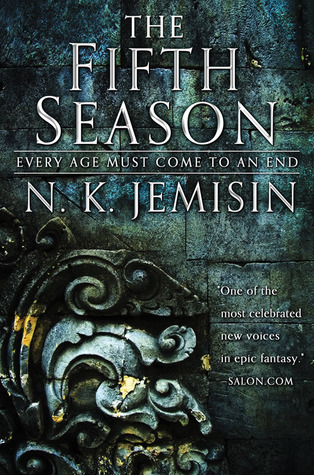
The Fifth Season (The Broken Earth) by N. K. Jemisin
This is the second Hugo nominee I have read this year.
The book takes place (at least apparently) in fairly far-in-the-future Earth, where seismic activity is much more powerful than today. There are periods of catastrophes, “seasons” which happen about every few centuries, when practically everything is destroyed and only the most prepared (and ruthless) communities survive. But a few people have an innate ability to control the Earth, quell earthquakes and even tame developing volcanoes. As they may be very dangerous, all “orogenes” (or “roggas”) are taken to a special school and controlled very carefully by “guardians,” who have an ability to negate their powers. Most communes fear and hate the roggas, and if the guardians don’t find the gifted children, they often are killed by locals. (Often the children have by that time accidentally caused some deaths with powers they can’t yet really control).
In the beginning, the book follows three apparently separate plot lines. Pretty soon it starts to seem fairly obvious how the plots connect--and they do eventually connect with each other just the way I was thinking they would.
In one plot line, a young girl is found to be an orogene, and she is picked up to be taken to the special school.
In another, an older woman with several children runs away from a country town to find her child, who has been captured, and a season seems to be bringing chaos everywhere.
In the third one, a young woman with fairly good orogeny skills is paired with an extremely powerful, slightly older man with apparently the best skills anyone has ever had. They are supposed to get children--children with their powers, even if neither of them is very keen on that idea.
The writing was very good and the converging plot lines were fascinating and interesting and even exciting. The characters were well drawn and engaging, as was the world with relics left behind by past, destroyed, civilizations. The way orogones “communicated” with Earth and geological layers was also well described and novel. This is one of the better books I have read in some time, and it certainly will be pretty high on my voting list. There is one fascinating detail: the book might by chance have an accidental connection with another of this year’s Hugo nominees...
449 pp.
Proofreading by eangel.me.
Thursday, June 2, 2016
Ancillary Mercy by Ann Leckie
This is the first of the Hugo nominees I have read this year. It is the concluding part of the trilogy, of which the former parts have also been nominees - and the first part won practically all genre awards that existed. This book continues the story, where an authoritative ruler of local area of space (whose mind has been uploaded to several ”ancillaries” for centuries) has “fractured” and is fighting a kind of civil war against herself. The emphasis of this book is on the ship minds, powerful AIs, who control spaceships and space stations. They have been considered just as machines without real self-awareness, but it turns out that they are capable beings with agendas of their own - or at least agendas which aren’t the same as the dictator's. A refreshingly alien race has sent a new representative, or “translator”, who looks human, but whose behavior is probably closer to that of the aliens. The aliens will keep up their agreement with humans only if humans will keep their part of the agreement, and the aliens think that humans are worth being taken seriously. The ongoing civil war threatens this balance and might cause serious consequences.
The book was pretty good, but probably not as good as the second part of the series. The first quarter was pretty slow with endless discussions, mostly while drinking tea; if discussions didn’t happen while tea drinking, the subject of the discussions was the planning of having a cup of tea. The alien translator was by far the most interesting character, and I would have loved to read more about her (the word “she” is used for everyone in this book). Now she was more of a side character. A good book, but it won’t probably be my first choice in the voting.
330 pp.
Proofreading by eangel.me.
Subscribe to:
Posts (Atom)